Brussels – December 4, 2025
The Law and Democracy Support Foundation (LDSF) participated in a high-level policy dialogue organized by the European Parliament in cooperation with the Office of the UN High Commissioner for Human Rights and the European Working Group on Combating Transnational Repression, of which LDSF is a member.
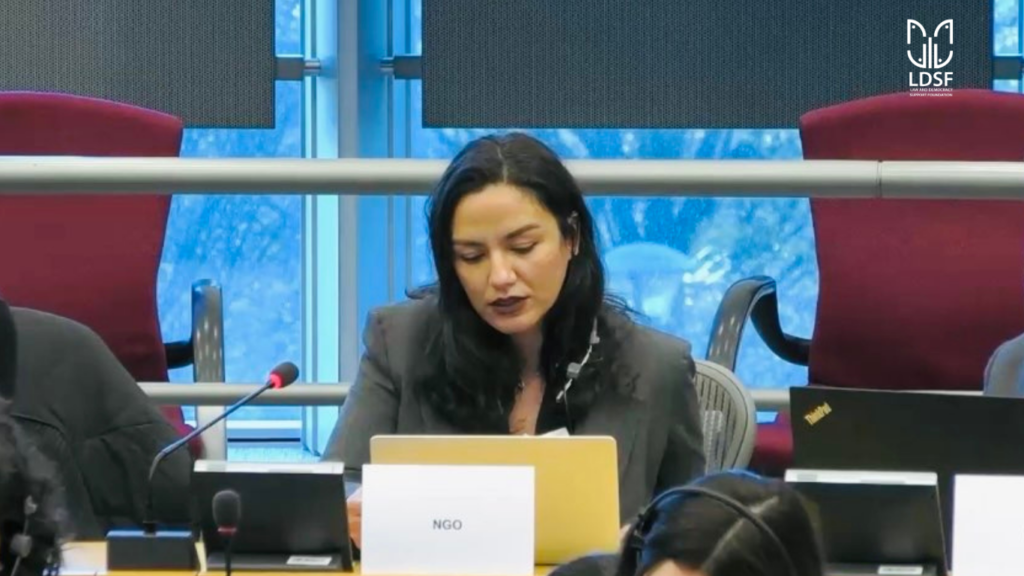
Representing the foundation was Basma Mostafa, Egyptian human rights defender and Programs Director, who delivered a speech stressing the urgent need to ensure accountability to protect exiled activists from transnational repression.
At the end of the session, Mounir Satouri, Member of the European Parliament and Chair of the Subcommittee on Human Rights (DROI), addressed the German delegation directly, referring to the points raised by Basma Mostafa on the lack of accountability in cases of transnational repression and urging the delegation to take her case seriously. This interaction reflects the impact of exiled defenders’ voices in shaping political debates within the European Parliament and underscores that combating transnational repression requires practical commitments from European states to guarantee protection and accountability.
Excerpt from Basma Mostafa’s Speech:
Thank you, Chair.
I want to offer a first-hand perspective on the reality of life for exiled activists.
Sophia Tekwani, an exiled Zimbabwean activist in Sweden, saw her son abducted and raped in 2022. Two years later, she herself was raped near the Zimbabwean Embassy in Stockholm—punishment for speaking out. If the perpetrators had faced justice after the first crime, she might have been spared further reprisals, and her family has still not been granted asylum.
Saudi activist Abdulrahman Al-Khaldi has been detained for years in Bulgaria and now faces deportation to Saudi Arabia, where he risks torture or even execution. His case shows how states collaborate.
I too have faced similar patterns. Three years ago, I was assaulted in Berlin, threatened with rape, my home address exposed, under surveillance by Egyptian diplomats, and subjected to smear campaigns—all carried out by an Egyptian transnational network acting on behalf of the regime and operating between Berlin, Amsterdam, Paris, and London. My case is recognized at the UN level and publicly acknowledged by the German government—yet there has been no justice. I still receive threats while living at the same exposed address the German police advised me to leave. This is what “protection” looks like: our backs against the wall. Because there was no accountability, the same network went on to commit new crimes in other cities. With no coordination between states, I had to report this transnational network separately to authorities in every country—on my own. Without any result.
The most critical element in combating transnational repression is ensuring accountability. Without it, declarations remain words on paper. Only real accountability will deter perpetrators from attacking us further and raise the cost of committing TNR. Accountability should not be compromised for bilateral relations. So how will EU institutions and Member States ensure real justice for us by turning this resolution into enforcement and ensure these measures apply without exception, even to close allies—including Egypt?
Watch the full session here:
As part of this work, LDSF co-founded Germany’s first civil coalition against transnational repression in August 2024, bringing together twenty diaspora-led organizations. Thanks to advocacy efforts in which LDSF played a pivotal role, the German federal government committed for the first time in its coalition agreement to combat transnational repression and recognize it as a direct threat to human rights and democracy.
We are proud to have succeeded in placing the Egyptian regime on the global map of transnational repression, through UN mechanisms such as special rapporteur complaints and the Universal Periodic Review, as well as European mechanisms—after years of focus on China, Russia, and Iran. We see this as a crucial step in our mission: raising awareness of human rights violations, amplifying the voices of exiles, and ensuring that transnational repression is firmly embedded in political and human rights agendas—affirming that Egypt is no exception to this phenomenon.