Law and Democracy Support Foundation (LDSF) expresses its deep concern over the systematic escalation of arbitrary arrest and detention policies targeting Sudanese refugees and asylum seekers in Egypt. These practices have clearly moved beyond isolated incidents and now reflect a broader security-driven pattern that flagrantly disregards Egypt’s international and constitutional obligations.
This escalation comes at a critical moment that prompted four senior UN mandate holders to issue a formal communication to the Egyptian government, criticizing the alarming rise in arrests—including of individuals registered with UNHCR—which signals a severe erosion of the humanitarian protection framework available to refugees.
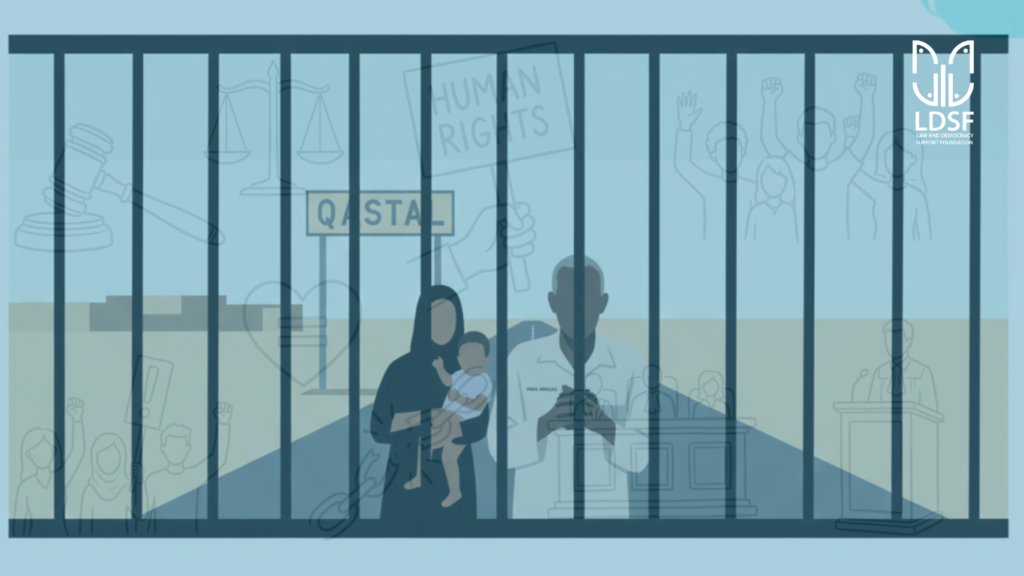
LDSF has documented, with grave concern, a pattern of arbitrary detention targeting registered refugees and asylum seekers who are apprehended solely for not carrying their identification documents at the moment of arrest, despite holding valid protection documents. In numerous documented cases, authorities have refused to release detainees even after their families or legal representatives submitted the required documents. Instead, detainees were transferred to closed detention facilities—often a precursor to attempts to move them to border areas for forcible return, in clear violation of the principle of non-refoulement and national laws governing asylum.
LDSF has also recorded the use of legally deceptive practices designed to circumvent the prohibition on refoulement. Refugees are frequently forced to choose between prolonged detention in inhumane conditions or signing so-called “voluntary return” forms. The foundation has documented cases where families were compelled to pay money labeled as “deportation fees” without any legal basis or official receipts. These circumstances make it evident that such “consents” are extracted under material and psychological coercion, rendering them devoid of genuine voluntariness.
LDSF draws attention to the profound humanitarian impacts of these practices. Arbitrary detention and the constant threat of deportation tear families apart and push those from highly vulnerable groups into dangerous or degrading situations. Continued detention of registered refugees without enabling communication with their families or legal representatives constitutes a grave breach of minimum standards of humane treatment.
These abuses cannot be separated from the broader context recently documented by LDSF, in which “immigration-related detention” has shifted from an exceptional measure to a tool of pressure, coercion, and physical and psychological abuse—leading to tragic deaths in detention facilities, including of refugees holding valid protection documents.
One of the most striking examples is the death of Sudanese asylum seeker Al-Nazir Al-Sadiq, a third-year secondary school student who died in custody at Badr Police Station in Cairo on 11 February 2026, after 25 days of detention. Although he possessed valid residency documents at the time of his arrest on 18 January 2026 outside his home, he was subjected to “inhumane” detention conditions. His family reported receiving credible information that he was exposed to harsh treatment and held in cold conditions without sufficient clothing, blankets, or bedding—ultimately leading to his death in detention. LDSF also learned that Al-Nazir’s family was forced to leave Egypt and return to Sudan, despite the severe security risks they face there.
Another tragic case is the death of Sudanese asylum seeker Mubarak Qamar Al-Din Majzoub (67), who passed away inside Al-Shorouq Police Station in Cairo on 5 February 2026, despite holding a valid UNHCR protection document valid until 2027.
These repeated incidents underscore the dangers of relying on unregulated administrative detention as a systematic practice lacking accountability mechanisms. They stand in direct contradiction to Egypt’s obligations under the 1951 Refugee Convention, its 1967 Protocol, the International Covenant on Civil and Political Rights, and the Egyptian Constitution—which grants international treaties the force of law, prohibits discrimination, and guarantees the right to dignity and personal security.
LDSF calls for:
Effective judicial oversight over all detention and deportation decisions.
An immediate halt to all deportation or forcible transfer operations targeting Sudanese refugees
Full respect for UNHCR-issued documentation and an end to the arbitrary detention of its holders
Unrestricted access for detainees to communication with their families and legal representatives
Independent and transparent investigations into recent deaths in detention
An end to coercive practices that force refugees into signing “voluntary return” forms