Berlin, 25 February 2026
Law and Democracy Support Foundation (LDSF) condemns the escalating pattern of mass forced deportations carried out by the U.S. Immigration and Customs Enforcement (ICE) against Russian asylum seekers, through special chartered routes that systematically use Cairo International Airport as a transit point to Moscow. Verified information and documentation collected by LDSF—including testimonies, and credible human rights and media reports—confirm that these operations, which have affected between 180 and 200 asylum seekers across five major group deportation flights since the summer of 2025 and until January 2026, are conducted in an environment devoid of the minimum standards of international protection. This has effectively transformed Cairo Airport’s transit area into a “legal black hole” and a trap for refoulement. LDSF further condemns the role of Egyptian authorities in enabling these violations by using physical coercion to block the last avenues of appeal for Russian dissidents and forcing them to continue their journey to a destination where they face real risks, including immediate arrest, coercive interrogations, and forced conscription.
In 2025 alone, four flights were carried out in June, August, September, and December. All followed a fixed route, during which field testimonies revealed severe violations inside the transit area, where deportees were transported in shackles and chains under degrading and inhumane conditions. Among the most alarming incidents is the case from the August 2025 flight, during which Egyptian security personnel used excessive physical force to restrain Russian dissident Artyom Vovchenko in his seat on a plane bound for Moscow despite his pleas for help. He was arrested immediately upon arrival. Passengers on the December 2025 flight received instant military draft notices, compelling them to report directly to combat fronts.
This is not an isolated incident; reports indicate that other deportees—who attempted to seek protection within Cairo International Airport—were subjected to physical assault and beatings by Egyptian security personnel to force them to continue the journey. This was the fate of activist Leonid Melekhin, who entered the United States through official channels fleeing repression in the Russian city of Perm. Despite this, he was forcibly deported via the Egyptian transit route, only to be arrested immediately upon arrival in Russia. He now faces a five-year prison sentence on charges of ‘justifying terrorism’ due to his peaceful activism—a case that proves Cairo Airport has been transformed into a calculated trap designed to shut down all avenues of escape for protection seekers.
Continuing this systematic pattern, the most recent operation departed from Mesa Airport in Arizona on 25–26 January 2026 and included dozens of deportees from Russia, Iran, and Arabic-speaking countries. The flight included individuals whose legal cases were still pending before U.S. courts; deportation was prevented for only nine of them at the last moment due to legal and advocacy pressure, while dozens were forcibly transferred through Cairo to Moscow.
LDSF emphasizes that shifting deportations from regular commercial flights to special chartered flights that designate Cairo Airport as a mandatory transit hub is not merely a logistical modification. It reflects a deliberate security strategy aimed at denying deportees the right to seek protection during transit and effectively “sealing off all escape routes.
LDSF stresses that stripping deportees of communication tools inside Cairo Airport, coupled with the use of physical coercion to force them onto return flights, eliminates the status of the transit area as an international safe zone and turns it into a “legal black hole” where Egypt’s international obligations are marginalized. The presence of deportees inside Cairo Airport places them under the effective jurisdiction and control of Egyptian authorities, which creates a direct sovereign obligation to ensure their access to international protection procedures and to prevent their transfer to any destination where they face real risks of torture or persecution.
It is important to note that preventing disembarkation during transit and denying deportees access to the UN High Commissioner for Refugees (UNHCR) constitutes a grave violation of international law—specifically:
- Article 33 of the 1951 Refugee Convention (prohibition of expulsion or refoulement)
- Article 3 of the Convention Against Torture (prohibition of transfer to states where individuals face a real risk of torture)
- The International Covenant on Civil and Political Rights (ICCPR) (guarantees of liberty, security, and due process) and the established norms of customary international law regarding the principle of non-refoulement.
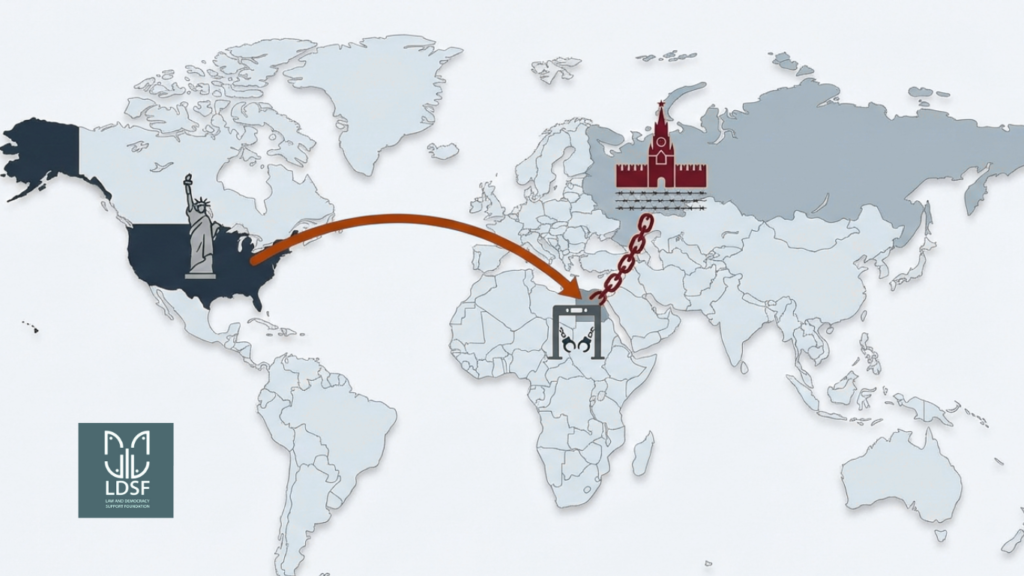
The U.S.–Egypt–Russia route represents a tightly interconnected model of ‘outsourced transnational repression,’ resulting in de facto refoulement through a chain of coordinated roles. The United States initiates the forced deportation via special flights despite its prior knowledge of the risks associated with sending deportees to Russia through Cairo, and despite the absence of protection and due process guarantees during transit. Egypt, in turn, coerces passengers into completing their journey to Russia with total disregard for the grave harm awaiting them upon arrival. Meanwhile, Russia—the ultimate beneficiary—imposes predictable retaliatory measures on the returnees, including arrest, torture, and forced conscription. This enables the Russian authorities to extend their reach against dissidents abroad and send a clear message: that escaping the country does not guarantee safety from persecution and repression.
LDSF underscores that all information included in this statement is based on consistent testimonies and thoroughly verified credible sources. The foundation calls on relevant authorities in all implicated states to initiate an independent and transparent investigation to ensure accountability.
LDSF recommends the following:
First – To the Egyptian Authorities
- Cease the use of force or coercion to carry out deportations in transit and ensure the safety and dignity of passengers, while enabling access to international protection mechanisms.
- Guarantee deportees’ access to the UNHCR office within transit zones.
- Allow deportees to exercise their right to choose an alternative safe destination and cease functioning as a “mandatory passageway” that blocks asylum seekers from seeking help.
- Establish a clear protocol for handling asylum claims in transit, including written guidelines circulated among police, border guards, national security, and ground service companies, explicitly prohibiting arbitrary restrictions on freedom of movement and any use of force to impose forced deportation.
Second – To the U.S. Government
- Conduct an immediate legal review and suspend all special charter flights via Cairo that circumvent judicial oversight and expose asylum seekers to indirect handover to Russian security services.
- Disclose the nature of security coordination with Egyptian and Russian authorities regarding protection guarantees and allow independent auditing mechanisms for lawyers and rights organizations.
- Ensure that asylum seekers who have exhausted legal pathways in the U.S. can select a safe alternative country and halt all forced deportations along routes that ultimately lead to their unsafe return to Russia.
Third – To UNHCR
- Activate an “immediate notification” mechanism obliging airport authorities to inform UNHCR of any protection request made in transit and guarantee access for lawyers (legal partners) before any deportation decision is implemented.
- Issue periodic reports documenting the state of refugee protection in airports to ensure accountability and pressure signatory states to provide “emergency protection visas” or rapid evacuation pathways for individuals trapped in legal grey zones.