
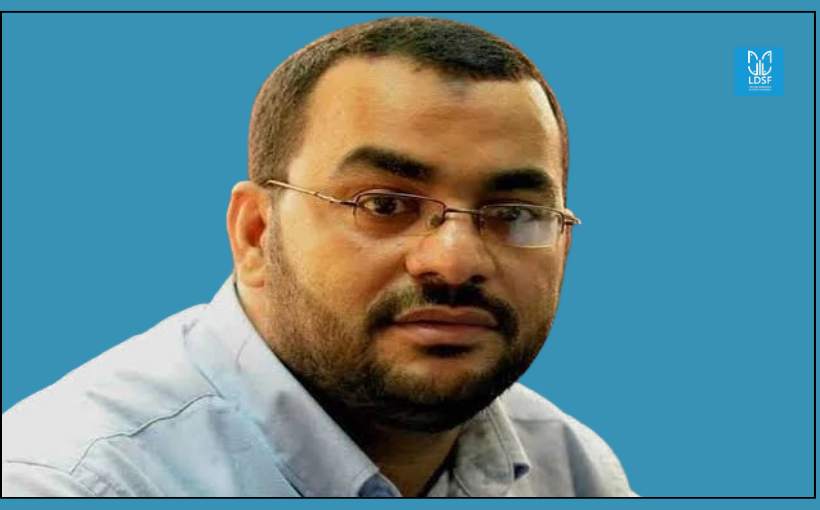
The trial of Yasser Abu Al‑Ela, who has been held in pretrial detention for more than two years, stands in direct contradiction to the Egyptian authorities’ claims of improving human rights conditions, instead reaffirming the absence of any genuine space for freedom of expression in Egypt. According to the Egyptian Journalists Syndicate, at least 19 journalists remain behind bars, many of whom have exceeded the legal maximum period of pretrial detention.
In addition to Yasser Abu Al‑Ela, those prosecuted in the same case include cartoonist Ashraf Omar. Other journalists currently detained include Safa Al‑Korbeigi, Karim Ibrahim, Mostafa Al‑Khatib, Ahmed Sabeeh, Badr Mohamed Badr, Mahmoud Saad Diab, Hamdy Mokhtar, Tawfik Ghanem, Mohamed Saeed Fahmy, Mohamed Abu Al‑Moaty, Mostafa Saad, Abdullah Samir Mubarak, Medhat Ramadan, Ahmed Abu Zeid Al‑Tantawi, Ramadan Goweda, Khaled Mamdouh, and Hussein Karim.
Moreover, Reporters Without Borders ranked Egypt 169th out of 180 countries in its 2026 World Press Freedom Index, noting that “Egypt remains one of the world’s largest prisons for journalists, who are regularly subjected to the repression of Abdel Fattah al‑Sisi’s military dictatorship,” and that “pluralism is virtually nonexistent in the country.”
Egyptian security forces arrested Yasser Abu Al‑Ela on 10 March 2024, after which he was forcibly disappeared for nearly 50 days before being brought before the Supreme State Security Prosecution. During questioning, he reported that he had been subjected to physical and psychological torture during his period of enforced disappearance. His wife, Naglaa Fathi, and her sister were also arrested on 27 April 2024 and held in an undisclosed location before appearing before the prosecution on 11 May 2024, reflecting a recurring pattern of targeting journalists’ family members as a means of pressure and collective punishment.
During periodic renewals of his pretrial detention, Abu Al‑Ela announced that he had gone on a hunger strike in protest against his conditions of detention, which included solitary confinement, denial of family visits, and the imposition of severe restrictions on his ability to leave his cell. Such practices amount to cruel, inhuman, and degrading treatment, which is prohibited under international human rights law.
On 10 November 2024, the Terrorism Criminal Court, convening at the Badr Court Complex, issued an in absentia ruling sentencing Yasser Abu Al‑Ela to life imprisonment in Case No. 339 of 2022 (Supreme State Security Investigation), while he remained detained in connection with Case No. 1568 of 2024 (Supreme State Security), which was later referred to trial.
In recent months, the Egyptian authorities have promoted a narrative of improving human rights conditions. This messaging comes at a time when Egypt faces fragile economic prospects and heightened regional uncertainties. Unfortunately, the narrative of alleged human rights and rule of law progress in Egypt has no basis in fact beyond illusory façade gestures. The crackdown on freedom of expression and of the media persists, as exemplified by the prosecution of journalist Yasser Abu Al‑Ela. Other trends of human rights violations continue unabated, including the punitive use of mass arbitrary detention, unfair trials, enforced disappearance, and torture — including the use of sexual violence — against peaceful dissent; the denial of rights to political participation, notably through free and fair elections; the targeting of religious minorities; as well as the judicial and security harassment of human rights defenders, media workers, scholars, trade unionists, and peaceful politicians and activists for exercising their rights.
Political prisoners and prisoners of conscience remain one of the most pressing human rights issues left unaddressed in Egypt. Limited presidential pardons do not indicate a meaningful remedy to their situation, nor are there any indications of a decrease in the overall number of political detainees. On the contrary, the scale of prosecutions remains deeply alarming. Prominent figures such as Ahmed Douma and Sayed Moshagheb have been re‑arrested and brought up on new charges shortly after their release, following the completion of unjust prison sentences. Moreover, approximately 6,000 individuals were referred to trial before terrorism court circuits within just eight months, between late 2024 and May 2025, after most had spent prolonged periods in pretrial detention.
The signed organizations:
- Cairo Institute for Human Rights Studies (CIHRS)
- Law and Democracy Support Foundation (LDSF)
- El Nadeem Center against Violence and Torture
- Committee For Justice (CFJ)
- Egyptian Front for Human Rights (EFHR)
- HuMENA for Human Rights and Civic Engagement

1 thought on “Joint Statement: Journalist Yasser Abu Al‑Ela and Others on Trial Expose the False Narrative of Human Rights Progress in Egypt”