
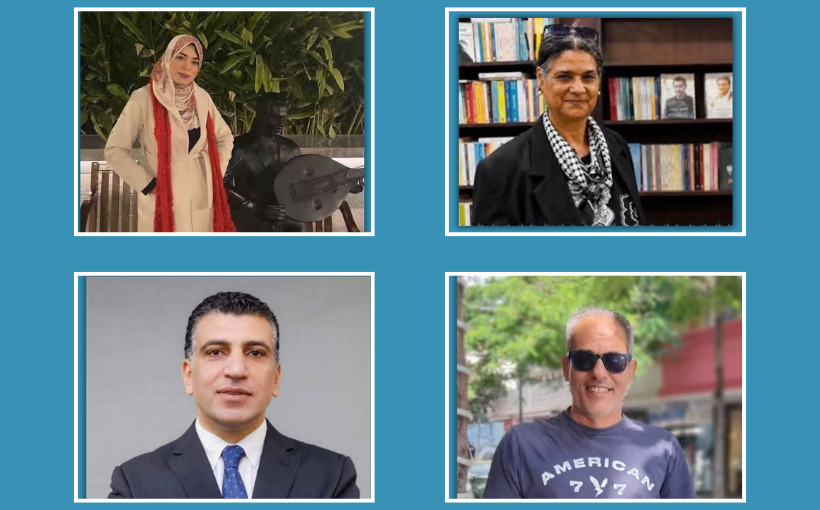
Law and Democracy Support Foundation condemns the sweeping security campaign carried out in Egypt over the past few days, which has targeted a number of activists, lawyers, and defenders of freedom of expression. This escalation reflects a continuing policy of closing the public sphere and imposing a tight security grip on spaces for expression, with the aim of suppressing and silencing dissenting and independent voices that address the country’s deteriorating human rights situation.
Egyptian security forces arrested, in the early hours of Monday, 25 May, and in separate incidents, members of the Committee for the Defence of Prisoners of Conscience: lawyer Mohamed Abou Al-Diyar, political activist Hanan Al-Tantawi, and Court of Cassation lawyer Wafaa Al-Masry from their homes. These arrests came days after the Committee organized a photo exhibition entitled “Prison Is Not Their Place,” in solidarity with prisoners of conscience in Egypt and calling for their release, and only hours after the Committee issued a statement condemning the arrest of political activist Nael Hassan and his pretrial detention on charges related to his online expression.
In the early hours of today, a security force raided the home of lawyer Mohamed Abou Al-Diyar and arrested him. This was followed, only a few hours later, by another security raid on the residence of Court of Cassation lawyer Wafaa Al-Masry while she was with her family including children where she was arrested in their presence. The authorities also confiscated the family’s mobile phones and prevented them from communicating with others for several hours.
Subsequently, a separate security force arrested political activist Dr. Hanan Al-Tantawi, a founding member of the Committee for the Defence of Prisoners of Conscience, in front of her home in Hadayek Al-Ahram, Giza.
This sweeping security campaign was preceded by similarly aggressive and escalating measures targeting the families of prisoners of conscience on 17 May 2026, when a number of families were subjected to arrest operations, threats, and harassment, coinciding with the conclusion of the “Prison Is Not Their Place” exhibition.
It should be noted that, yesterday, Sunday 24 May, the Supreme State Security Prosecution ordered the pretrial detention of political activist Nael Hassan for 15 days pending investigation in Case No. 4373 of 2026 (Supreme State Security). He faces charges of spreading false news and using an online platform to promote terrorist ideas, following his appearance before the prosecution after being subjected to enforced disappearance for several days since his arrest on 21 May 2026.
Nael had previously received a phone summons from the National Security Agency in Alexandria on 20 May. He went the following day to the agency’s headquarters in the Abis area, after which all contact with him was lost and he forcibly disappeared until he was later brought before the Supreme State Security Prosecution. As is routinely the case, the prosecution disregarded his enforced disappearance and proceeded to initiate investigations against him.
This is not the first time Egyptian authorities have targeted Nael Hassan. He was previously arrested in August 2025 and released on the same day. He was also arrested on 21 April 2017 in connection with protests against the maritime border demarcation agreement, and remained detained until his release in April 2018.
Mohamed Abou Al-Diyar had previously been subjected to detention in connection with his role as campaign manager for politician Ahmed El-Tantawi during the 2023 presidential elections. The Mataria Misdemeanor Appeals Court upheld a one-year prison sentence against him, to be enforced with hard labor, alongside a five-year ban imposed on El-Tantawi from running in elections.
During that period, Law and Democracy Support Foundation documented systematic violations, including intimidation outside notary offices, obstruction of the issuance of powers of attorney, and the arrest of campaign members and supporters. These violations were compounded by breaches of fair trial guarantees, reflecting the use of the criminal justice system as a tool to undermine the right to political participation.
The Egyptian authorities remain entrenched in their reliance on security-driven approaches to silence critical voices and close the public sphere, in an attempt to impose a complete blackout on their failures in the areas of human rights and the deteriorating political and economic situation. Rather than responding to civil society’s calls, pursuing meaningful political solutions, halting the systematic targeting of dissenting voices and their defenders, and releasing prisoners of opinion and conscience, they continue to deepen the crisis by resorting to security measures and prosecuting individuals for their views, as well as those who defend them.
This reflects a deliberate strategy to bring the public sphere fully under control through the spread of fear and intimidation. Such an approach undermines any possibility for independent civic action or genuine political participation, and reinforces an increasingly evident reality: repression is no longer an exception, but has become a governing policy.
This security escalation comes in the wake of similar crackdowns witnessed in Egypt in recent weeks, targeting a range of public figures. These include filmmaker and screenwriter Omar Salah Marei, who was arrested on 11 May and whose pretrial detention was renewed today by the Supreme State Security Prosecution for a further 15 days; poet Ahmed Douma, who is awaiting a verdict in his trial on charges of spreading false news, scheduled for 3 June 2026; and cartoonist Ashraf Omar, who is due to appear before a terrorism circuit on 13 July 2026 on fabricated charges related to terrorism financing.
The wave has also affected poet Galal El-Behairy, whose trial hearing has been set for 10 June, and filmmaker Abdelrahman El-Ansari, who was rearrested after previously spending more than seven years in detention on similar charges. Prominent football fan Sayed “Mashagheb” was also rearrested just hours after his release, following more than 11 years in prison. In addition, at least 19 journalists remain behind bars.
Law and Democracy Support Foundation reiterates its call on the Egyptian authorities who continue to ignore the appeals of civil society and their international obligations to immediately halt this systematic targeting of freedom of expression, release all prisoners of opinion and conscience, and drop the fabricated charges brought against them.


1 thought on “Egypt: Lawyers and Activists Arrested in Sweeping Security Crackdown on freedom of expression”