
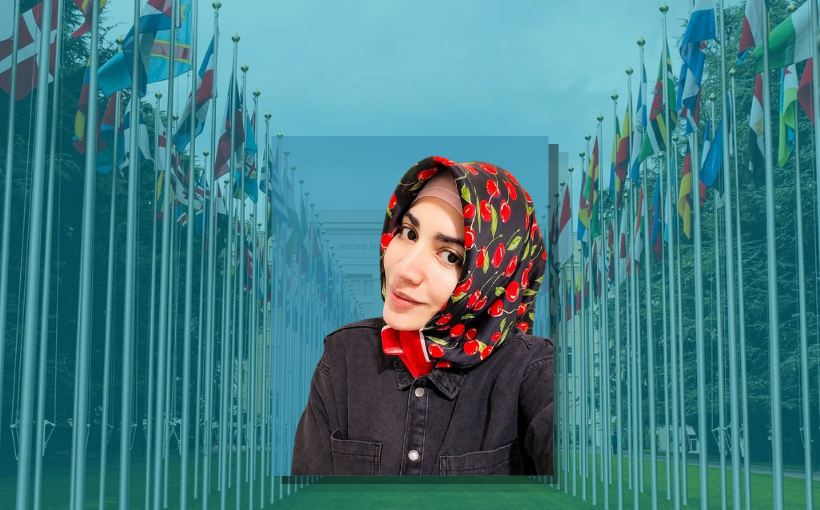
Six United Nations human rights mandate holders have issued formal communications to the governments of Egypt and Oman regarding the case of Egyptian activist Mariam Abdelbasette and her husband, Ahmed Mousa. The experts expressed concerns relating to enforced disappearance, arbitrary detention, freedom of expression, and the use of counter-terrorism measures and cross-border security cooperation against political dissidents.
The communications, dated 18 June 2026, were issued on the basis of information, documentation, and a submission provided by Law and Democracy Support Foundation (LDSF) to the UN Special Procedures, documenting the targeting of Mariam Abdelbasette and Ahmed Mousa in connection with their peaceful exercise of the rights to freedom of expression and participation in public affairs through online platforms.
The communications were signed by the Special Rapporteur on the promotion and protection of human rights and fundamental freedoms while countering terrorism, the Working Group on Enforced or Involuntary Disappearances, the Special Rapporteur on the promotion and protection of the right to freedom of opinion and expression, the Special Rapporteur on the rights to freedom of peaceful assembly and of association, the Special Rapporteur on violence against women and girls, and the Working Group on discrimination against women and girls. The UN experts simultaneously addressed both the Egyptian and Omani governments, reflecting the transnational nature of the case and the cross-border human rights violations involved.
UN Calls on Egypt to Clarify the Fate and Whereabouts of Ahmed Mousa
The UN experts expressed grave concern regarding the reported enforced disappearance of Ahmed Mousa following his deportation from the Sultanate of Oman to Egypt on 9 April 2026. They noted that neither his family nor his lawyer had been able to obtain any information concerning his whereabouts, legal status, or health condition, despite repeated inquiries to the relevant Egyptian authorities. The experts called on the Egyptian government to clarify his fate and whereabouts, disclose his place of detention, and provide the legal basis for the measures taken against him.
The United Nations also requested detailed information from the Egyptian authorities regarding the case brought against Mariam Abdelbasette, including the legal and factual basis for the terrorism-related charges against her. The communication notes that the activities attributed to her appear to relate to peaceful online expression and participation in the administration of opposition political content while residing outside Egypt.
The experts further requested clarification regarding any requests, notices, international cooperation mechanisms, or Interpol-related measures that may have been used, or sought to be used, against Mariam Abdelbasette or Ahmed Mousa.
The experts also expressed concern regarding the gender-based threats and smear campaigns directed at Mariam Abdelbasette and members of her family, as well as the impact of these measures on her three children, including her newborn child.
In addition, the experts requested information from the Egyptian authorities regarding any investigations undertaken into the threats and smear campaigns targeting Mariam Abdelbasette and her family members, as well as the measures taken to ensure that counter-terrorism legislation and procedures are not used to restrict freedom of expression, freedom of association, or participation in public affairs.
UN Calls on Oman to Justify Mariam Abdelbasette’s Detention and Travel Restrictions
In their communication addressed to the Sultanate of Oman, the UN experts expressed concern over the detention of Mariam Abdelbasette in hospital following the birth of her child, the restrictions imposed on her ability to leave Oman, and repeated threats of deportation to Egypt without being informed of any clear legal basis or being afforded an opportunity to challenge the measures taken against her.
The experts requested that the Omani authorities clarify the legal basis for her travel ban, interrogation, and detention, and disclose any requests, notices, or information received from the Egyptian authorities or through Interpol channels. They also sought clarification as to whether there are plans to deport her to Egypt.
The experts further expressed serious concern that any deportation of Mariam Abdelbasette to Egypt could expose her to the risk of arbitrary detention, enforced disappearance, torture, or other grave human rights violations, particularly in light of her husband’s disappearance following his deportation from Oman to Egypt.
They called on the Omani authorities to take urgent measures to prevent any irreparable harm to Mariam Abdelbasette and her newborn child, including suspending any actions that could result in her deportation to Egypt until a proper assessment of the human rights risks associated with her case has been conducted.
The experts also requested that the Omani authorities clarify the legal basis for the deportation of Ahmed Mousa to Egypt on 9 April 2026, and indicate whether they carried out an assessment of the risks he could face prior to his deportation, including the risks of arbitrary detention, enforced disappearance, or other serious human rights violations, and whether the decision to deport him was consistent with the principle of non-refoulement.
UN Concerns over Transnational Repression
The communications devote significant attention to concerns regarding the use of counter-terrorism measures and cross-border security cooperation to target individuals for the peaceful exercise of their fundamental rights. The experts warned that such practices could have a broader chilling effect on political dissidents, human rights defenders, journalists, and others engaged in public affairs while living outside Egypt.
The experts also expressed concern regarding gender-based threats and smear campaigns directed at Mariam Abdelbasette and her family members, as well as the impact of these measures on her three children, including her newborn child.
Basma Mostafa, Director of Programs at LDSF, Said:
“The issuance of these two UN communications represents a serious international acknowledgment of the concerns that the Foundation has raised regarding this case from the outset. The communications highlight the urgent need to clarify the fate and whereabouts of Ahmed Mousa and to ensure the protection of Mariam Abdelbasette and her children from any measures that could expose them to further serious human rights violations or irreparable harm.”
“Mariam Abdelbasette ’s case is not an isolated one. Rather, it forms part of a broader pattern of transnational repression that the Foundation has documented over recent years. We have documented the targeting of Egyptians living abroad through politically motivated prosecutions, the misuse of terrorism-related accusations, proxy punishment through the targeting of dissidents’ family members inside Egypt, denial of official documents and consular services, cross-border threats, intimidation and smear campaigns, as well as attempts to misuse international security cooperation mechanisms to pursue dissidents beyond Egypt’s borders.”
“We have also documented the expansion of digital repression through the blocking and targeting of media platforms, political accounts, and personal social media accounts operated by Egyptians abroad, restricting their ability to communicate with audiences inside Egypt and participate in public life. This case underscores the need for stronger international oversight to ensure that security cooperation tools and international law-enforcement mechanisms are not misused in ways that undermine fundamental rights and freedoms.”
For the UN communication addressed to the Government of Egypt (UA EGY 4/2026), please visit:
https://spcommreports.ohchr.org/TMResultsBase/DownLoadPublicCommunicationFile?gId=31063
For the UN communication addressed to the Government of the Sultanate of Oman (UA OMN 2/2026), please visit:
https://spcommreports.ohchr.org/TMResultsBase/DownLoadPublicCommunicationFile?gId=31062




2 thoughts on “Six UN Experts Address Egypt and Oman Over the Case of Egyptian Activist Mariam Abdelbasette, Warn of Transnational Repression and the Risk of Refoulement”