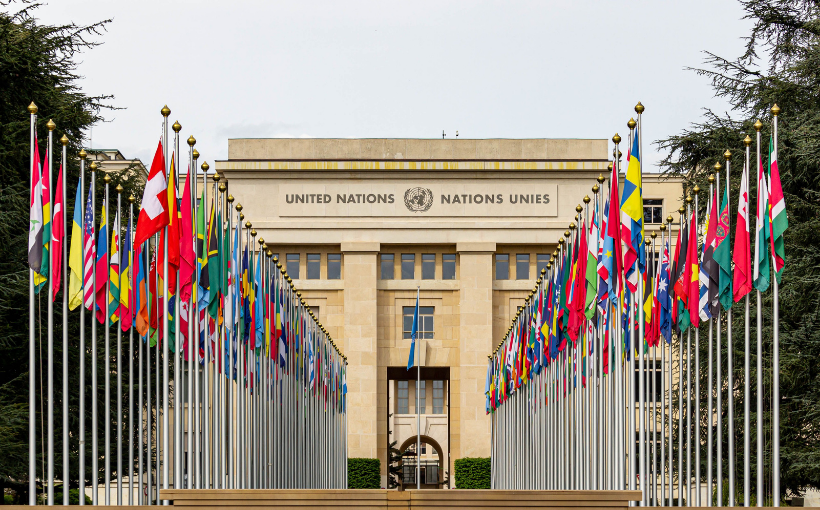
United Nations Office in Geneva. photo by Hugo Magalhaes via pexels
Law and Democracy Support Foundation (LDSF) welcomes the latest report of the United Nations Working Group on Arbitrary Detention (WGAD), which, for the first time, dedicates a thematic chapter to transnational repression and its connection to arbitrary detention. The report warns against the misuse of international security cooperation, including INTERPOL mechanisms, politically motivated prosecutions, trials in absentia, and the targeting of family members of dissidents and activists living abroad.
The report emphasizes that transnational repression takes multiple forms, including forcible transfer or deportation, politically motivated prosecutions, the abuse of extradition procedures and INTERPOL mechanisms, digital surveillance, and the targeting of relatives of political dissidents and human rights defenders who remain in their countries of origin.
The findings closely reflect patterns documented by LDSF in recent years in the Egyptian context, including reprisals against the families of dissidents residing abroad, politically motivated prosecutions, the use of terrorism-related charges against activists and political exiles, and persistent concerns regarding the misuse of international security cooperation mechanisms.
The Working Group further notes that the practice commonly referred to as “proxy punishment”, whereby relatives of dissidents or human rights defenders are targeted because of the activities of their family members abroad, violates the principle of individual criminal responsibility and may amount to arbitrary and discriminatory detention.
The report is of particular significance in light of recent cases highlighted by LDSF, including that of Egyptian activist Mariam Abdel Baset and Ahmed Mousa. The Working Group stresses that deportations or cross-border transfers carried out without adequate judicial safeguards, or in circumstances where individuals face a risk of arbitrary detention, enforced disappearance, or other serious human rights violations, may transform international security cooperation into a tool of transnational repression.
The report further underscores that States are obliged to uphold the principle of non-refoulement and ensure that deportation, extradition, and removal procedures are not used to facilitate human rights violations.
Basma Mostafa, Program Director at the Law and Democracy Support Foundation, stated:
“This report marks an important step toward growing international recognition of the dangers posed by transnational repression and its impact on human rights defenders, journalists, and political dissidents. It also reflects many of the patterns documented by LDSF in the Egyptian context, including the targeting of dissidents’ family members within Egypt, the misuse of terrorism-related charges, the denial of official documentation, and the risks associated with international security cooperation.”
She added:
“The significance of this report also lies in its affirmation that responsibility for addressing transnational repression does not rest solely with the States that perpetrate such violations. It also extends to host countries, which have an obligation to ensure that extradition requests, deportation proceedings, and forms of security and judicial cooperation are subject to effective judicial oversight and full human rights safeguards. It is essential that this growing recognition within the UN system be translated into concrete measures that strengthen protection for individuals targeted by transnational repression and prevent the misuse of international justice and cooperation mechanisms to pursue political dissidents and human rights defenders or expose them to the risk of arbitrary detention, enforced disappearance, or other grave human rights violations.”