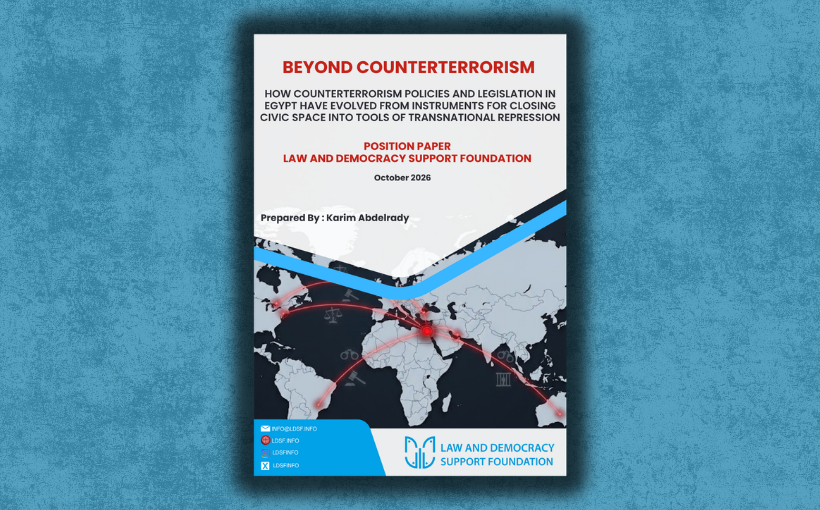
Law and Democracy Support Foundation (LDSF) is pleased to announce the publication of a new Position Paper entitled “Beyond Counterterrorism”, examining how Egyptian authorities have expanded the use of counterterrorism laws and policies to restrict civic space and suppress dissent. The paper further explores how the impact of these measures extends beyond Egypt’s borders, affecting Egyptians living abroad through various forms of transnational repression and the use of counterterrorism frameworks as tools to target and pursue individuals outside the country.
The paper analyzes three key laws: the Counterterrorism Law (Law No. 94 of 2015), the Terrorist Entities and Terrorists Lists Law (Law No. 8 of 2015), and the Anti-Cyber and Information Technology Crimes Law (Law No. 175 of 2018). It demonstrates how these laws are built on broad and vague definitions, extensive executive powers, and weak safeguards, enabling the targeting of opinion-holders, journalists, human rights defenders, and political opponents both inside and outside Egypt.
The paper identifies and documents eight patterns of transnational repression resulting from the application of counterterrorism policies and legislation, supported by documented examples:
- Criminalizing cooperation with individuals or entities operating abroad.
- Targeting the families of individuals residing abroad (proxy punishment).
- Smear campaigns and character assassination.
- Blocking websites and online accounts.
- Trials and prosecutions in absentia.
- Misuse of regional security cooperation mechanisms and INTERPOL.
- Inclusion on terrorism lists.
- Enforced disappearance.
The paper concludes that transnational repression is not a separate or exceptional policy, but rather a direct extension of a broader governance approach that prioritizes security solutions over dialogue, pluralism, and political reform. It argues that any serious response must begin with genuine political will and a restoration of the principle of the separation of powers.
The paper also presents recommendations addressed to Egypt’s legislative, judicial, and executive authorities, as well as to the international community. These recommendations include reviewing rights-restrictive legislation, ending security-driven targeting and transnational repression practices, ensuring proper oversight of security cooperation channels and INTERPOL mechanisms, and strengthening protection for those targeted in host countries.
To read and download the full paper: