
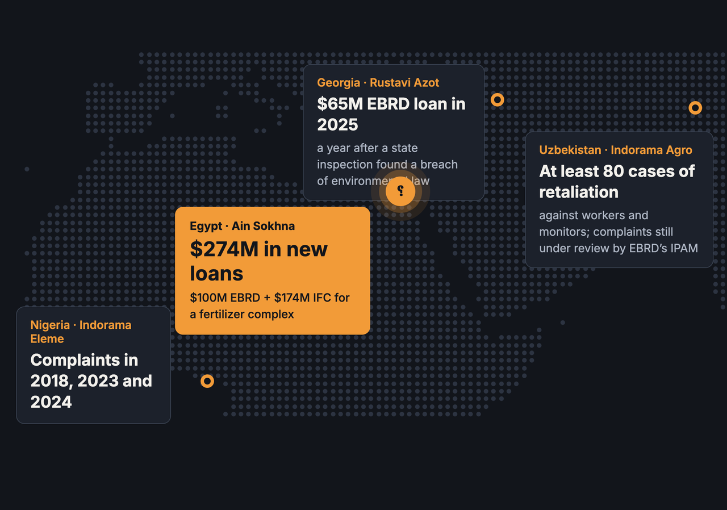
We, the 14 undersigned organizations, express concern about the decision of the European Bank for Reconstruction and Development (EBRD) to consider approval, on November 18, of a USD 100 million loan to Indorama Holdings B.V., a subsidiary of Indorama Corporation, for the creation of a phosphate fertilizer complex in Ain Sokhna, Egypt (Project No. 55287), in partnership with the state-owned Misr Phosphate Company. The project is co-funded by the International Finance Corporation (IFC), which will contribute a loan up to USD 174 million, approved earlier this month (Project No.49954).
We are especially concerned about the inadequate environmental and social assessments of the project impacts, the blatantly insufficient risk mitigation measures and standards for workers’ employment, living and working conditions, and the fact that several projects by Indorama Corporation and its subsidiaries have been reportedly linked with human rights violations, environmental harm and labour abuses. This is particularly worrying in the Egyptian context, where corporate accountability and redress are structurally undermined due to the suppression of freedom of association and information, and widespread internal repression.
The project-related documentation disclosed by the EBRD and IFC and compiled by the applicant – including the ESIA report, its annexes, and the ESAP report – presents significant omissions and proposes standards for workers’ conditions at the plant falling below the minimum standards enshrined in Egyptian law, and in the EBRD and IFC’s policies, informed by ILO Conventions and Guidelines.
The initial phase of the project – the construction of the fertilizer plant – will require accommodation for workers at the project site, located in an industrial area. The housing solution proposed in the ESIA, however, fails to meet the minimum standards set by Egyptian law, allocating “at least 4–6 m²” per worker and one shower for every 10 workers at accommodation facilities, whereas Ministerial Decree No. 200 of 2003 requires at least 6 m² and one shower for every 8 workers, nor does it clarify how such space will be distributed inside the facilities. The ESIA also contains no provision for women workers’ separate accommodation and hygienic facilities at the site, which is likely to deter women from applying. This indirect discrimination ignores the provisions set in Egyptian Labor Law No. 14 of 2025, including the requirement to provide housing suited to married workers and their families, when workers are required to reside at a project site.
The ESIA presents further concerning omissions, such as failing to mention whether basic commitments – granting one separate bed for each worker, equipping housing facilities with mosquito nets, fresh drinking water, and cooling systems, or enabling family visits – will be guaranteed. The report also mentions the use of CCTV at the housing facilities without clarifying what provisions will be put in place to avoid them being used to surveil workers and dissuade them from engaging in peaceful collective organising.
In accordance with EBRD and IFC policies, the ESIA reports that relevant stakeholders have been consulted. The process described, however, prominently excluded future workers and women, citing procedural difficulties. The only group that was reportedly consulted is the male elders from the neighboring town of Kabirat al-Amareen. It is unclear from project documents whether they were provided with an accessible and/or translated version of the voluminous and highly technical ESIA, ESAP, and annexes, nor whether Egypt’s highly repressive context was considered in the design of the consultation process.
Finally, as per EBRD and IFC policies, the ESIA describes a grievance mechanism that will enable any affected person or monitors to file complaints and seek redress. At closer inspection, however, the mechanism appears extremely problematic: the ESIA suggests that it will be operated by Indorama, without clarifying how potential conflicts of interest may be dealt with; nor does it indicate how the risk of retaliation will be mitigated, which is especially concerning in light of a documented pattern of retaliation connected to a previous Indorama project in Uzbekistan.
The Egyptian context does not offer adequate guarantees for corporate accountability, and retaliation is particularly harsh where large-scale, foreign-funded development projects are involved. Independent unions face severe restrictions under Law No. 213 of 2017, exposing labor rights defenders and workers to arrest, prosecution, or eviction. Journalists also face retaliation in the form of arbitrary arrest and detention, torture, and prosecution for terrorism charges in highly flawed court proceedings. Egypt ranks 135 of 143 nations in rule of law and last among countries in the Middle East and North Africa in the World Justice Project’s rule of law global ranking.
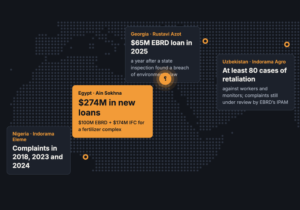
Indorama’s record of questionable corporate conduct is also a factor of concern. The EBRD is considering approving the loan while its own Independent Project Accountability Mechanism (IPAM) is still reviewing complaints filed by civil society organizations, workers, and farmers relating to the Indorama Agro cotton project, another subsidiary of Indorama Corporation, in Uzbekistan. Uzbek Forum for Human Rights documented illegal transfers of farmers’ land that took place without consent or compensation, and Bankwatch counts at least 80 cases of retaliation against workers and monitors.
In 2025, EBRD provided a $65 million loan to Indorama’s Rustavi Azot plant in Georgia, although the previous year a state inspection found the project in breach of environmental law. In Nigeria, workers and communities filed complaints about Indorama Eleme Fertilizer and Chemicals with the IFC’s Compliance Advisor Ombudsman (CAO) in 2018, 2023, and 2024, and with the US International Development Finance Corporation (DFC) in 2024, alleging pollution, harm to health and livelihoods, and labor abuses. In the 2018 case, the CAO found failures in the IFC’s supervision, particularly of alleged retaliation against workers.
In 2016, a complaint was filed with the CAO against Indorama Kokand (Uzbekistan) for its use of child and forced labor in its cotton supply chain.
These incidents do not seem to have affected Indorama’s capacity to secure loans from development banks such as the EBRD and IFC, either directly or through its subsidiaries.
No one has been held accountable for the social and environmental harm associated with Indorama’s activities in Nigeria, Georgia, and Uzbekistan, and yet a subsidiary of the group has been awarded new loans for a fertilizer production plant in Ain Sokhna, Egypt. Indorama’s record of questionable corporate conduct across multiple countries does not seem to have been considered by the EBRD and the IFC as a risk factor.
Civil society organizations raised these concerns with the EBRD and IFC before the Ain Sokhna project approval. While both banks consistently expressed confidence in Indorama’s capacity to comply with their standards, they did not present any tangible guarantees to prevent harm in the Ain Sokhna project.
We call for the following action:
- IFC should withhold the disbursement of a loan to Indorama for project No.49554 (the “Ain Sokhna fertilizer project”) until a revised ESIA and Environmental and Social Action Plans (ESAP) demonstrate that thorough human rights due diligence has been conducted, in line with IFC safeguards and Egyptian Decree No. 200 of 2003, and Law No. 14 of 2025.
- EBRD should desist from approving any further loans to Indorama Corporation and its subsidiaries, including for project No.55287 (the “Ain Sokhna fertilizer” project), until Indorama has demonstrated a sustained period of compliance with lender safeguards and taken responsibility for harm it has caused to project-affected communities in Uzbekistan, Nigeria, and Georgia.
- As a further condition of any funding approval regarding the Ain Sokhna project, the IFC and EBRD should require a revised ESIA that meets Decree No. 200 of 2003, Law No. 14 of 2025, and the IFC/EBRD guidance note Workers’ Accommodation: Processes and Standards; provides for women and married workers; and is based on new consultations that include women and workers.
- The Egyptian authorities should also review the Ain Sokhna project documentation to ensure compliance with domestic legal standards, inspect worker housing facilities at the site before it is occupied, and guarantee corporate accountability in compliance with domestic standards.
Signatures:
- EgyptWide for Human Rights
- Defenders in Development campaign (Campaign)
- Uzbek Forum for Human Rights
- Egyptian Front for Human Rights
- Egyptian Human Rights Forum (EHRF)
- Global Alliance for Incinerator Alternatives Asia Pacific
- Buliisa Initiative for Rural Development Organisation (BIRUDO)
- Alternative Law Collective (ALC)
- SynDev Senegal
- Law and Democracy Support Foundation (LDSF)
- International Accountability Project (IAP)
- Sinai Foundation for Human Rights
- Accountability Counsel
- HuMENA for Human Rights and Civic Engagement