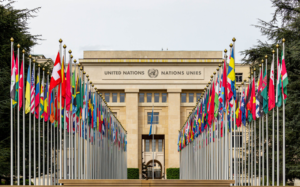

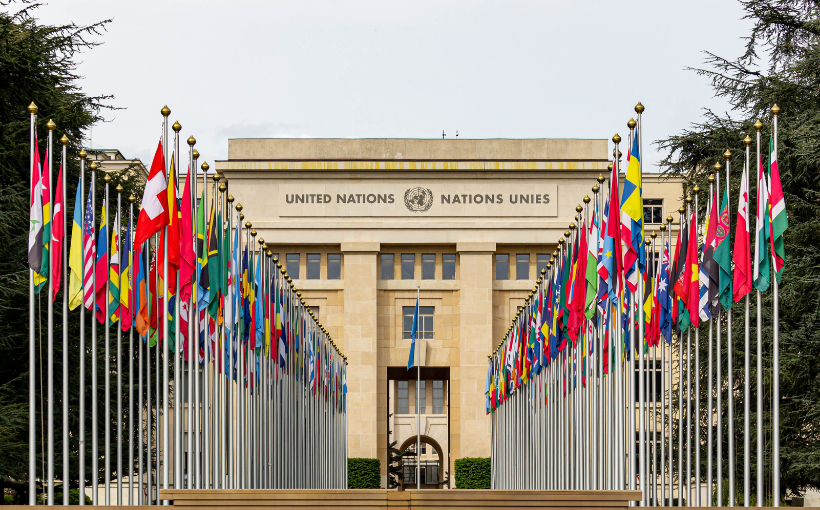
United Nations Office in Geneva. photo by Hugo Magalhaes via pexels
Drawing on its reports “Beyond Counterterrorism” and “Shield and Sword,” the Foundation warns against the misuse of terrorism and extremism narratives to target Egyptian dissidents abroad and calls for stronger international protection for individuals affected by transnational repression.
Berlin, 16 November 2026
Law and Democracy Support Foundation (LDSF) has submitted a formal contribution to the United Nations Special Rapporteur on the promotion and protection of human rights and fundamental freedoms while countering terrorism, in response to the call for inputs on transnational repression in counter-terrorism contexts and the concepts of “violent extremism” and “extremism.” The submission draws on legal analysis and human rights documentation produced by the Foundation on the impact of Egyptian counter-terrorism policies and legislation on Egyptians living abroad. It warns against the use of counter-terrorism frameworks and “extremism” narratives to justify patterns of transnational repression targeting dissidents, journalists, and human rights defenders.
The Foundation explained that its submission was primarily based on its policy paper,“Beyond Counterterrorism: Security Legislation as a Tool of Transnational Repression,” which examines how several Egyptian counter-terrorism and cybercrime laws, particularly Counter-Terrorism Law No. 94 of 2015, Terrorist Entities Law No. 8 of 2015, and Anti-Cybercrime Law No. 175 of 2018, have evolved from instruments used to restrict civic space domestically into mechanisms deployed to target and pursue Egyptian dissidents, journalists, and human rights defenders abroad, extending the impact of these laws beyond Egypt’s national borders.
The submission highlights multiple patterns of transnational repression, including trials in absentia, terrorism designations, restrictions on consular services and the issuance of official documents, retaliation against family members inside Egypt to pressure political opponents living abroad, as well as the use of regional security cooperation mechanisms in ways that may contribute to human rights violations.
The submission also addresses the decision issued by the Cairo Criminal Court on 10 November 2026 to place dozens of entities and individuals residing in Europe and other countries on terrorism lists without prior notification or adequate due process guarantees. The Foundation warned that such decisions may have serious consequences beyond Egypt’s borders, including damage to reputation, restrictions on financial rights and services, and limitations on freedom of movement.
In addition, the Foundation presented findings from its research report,“Shield and Sword: How the Egyptian Youth Union Abroad Pursues Dissidents and Critics in Europe?”, which documented patterns of intimidation, surveillance, smear campaigns, and targeting experienced by Egyptian dissidents in several European countries through networks and individuals closely connected to Egyptian state institutions. The report demonstrates how narratives of “countering terrorism,” accusations of “extremism,” and allegations of affiliation with terrorist groups have repeatedly been used to delegitimize political opponents and human rights defenders and to justify their targeting outside Egypt. The Foundation emphasized that these narratives constitute one of the principal mechanisms through which transnational repression is reproduced under a security pretext and called for such practices to be recognized and addressed as forms of transnational repression requiring accountability and protection.
With regard to the concepts of “violent extremism” and “extremism,” the Foundation stressed that the absence of clear and internationally agreed definitions creates significant risks for freedom of opinion, expression, and belief. It warned against the use of vague legal provisions to punish peaceful expression or non-violent views under the guise of counter-terrorism or countering extremism.
The submission concludes with a set of recommendations addressed to the Special Rapporteur, United Nations mechanisms, host states, INTERPOL, and relevant regional bodies. These recommendations call for stronger protections against transnational repression, full respect for the principle of non-refoulement, closer scrutiny of regional security cooperation frameworks, and safeguards against the misuse of counter-terrorism legislation to suppress peaceful civic and human rights activities. The Foundation also calls for an end to all forms of transnational repression and proxy retaliation, as well as effective remedies and accountability for victims.
This contribution forms part of the ongoing efforts of the Law and Democracy Support Foundation (LDSF) to monitor, document, and analyze transnational repression targeting activists, journalists, human rights defenders, and exile communities from the Middle East and North Africa, while promoting greater international accountability and protection for those affected.