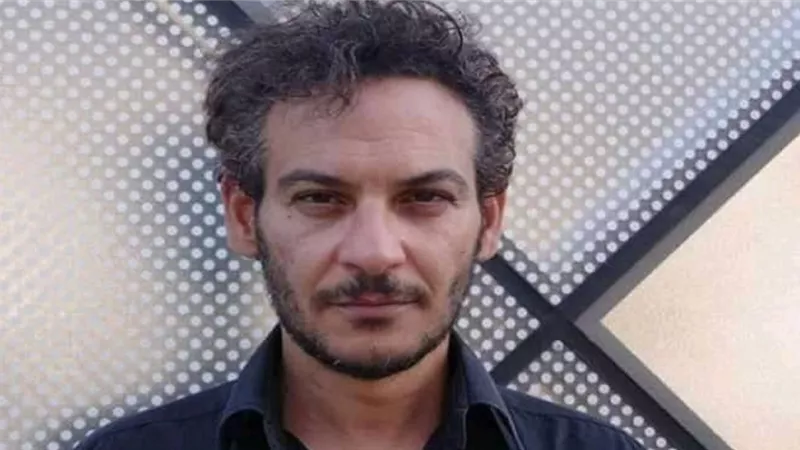
Egyptian writer Mohamed Alaa El-Din, who currently lives in Germany, announced in a post on Facebook that the Egyptian Embassy in Berlin had contacted him verbally to inform him that his request to renew his passport had been refused. Although the Consul General has reached out informally and promised to do everything he can to resolve the problem, the situation remains unchanged at the time of writing.
Mohamed Alaa El-Din is an Egyptian author, novelist and screenwriter. His first novel, Injil Adam (The Gospel of Adam), drew wide attention and was praised by several prominent writers, including Bahaa Taher and Sonallah Ibrahim. In 2011, Akhbar al-Adab magazine named him among the most important writers of the new millennium, and American writer Paul Totonji included him in his article “Five Egyptian Authors You Don’t Know, But Should Read.”
Mohamed was previously subjected to enforced disappearance in Egypt for one week, as part of a wave of arbitrary arrests that affected thousands of people during the events of September 2019, before the Public Prosecution later released him.
According to his post, the writer holds no nationality other than Egyptian. Halting the renewal of his passport effectively places a ban on his right to travel, work and move freely. This contravenes Article 13 of the Universal Declaration of Human Rights and Article 12 of the International Covenant on Civil and Political Rights, both of which guarantee freedom of movement and the right to leave any country, including one’s own, as well as Article 62 of the Egyptian Constitution, which guarantees freedom of movement, residence and migration. This extends to a citizen’s right to a passport, without being limited to it.
In September 2026, more than 130 experts, members of the UN Special Procedures and treaty bodies, acknowledged in their joint statement on transnational repression that denying consular services, cancelling or suspending passports, refusing to issue or renew identity and travel documents, and imposing arbitrary restrictions on movement are all among the tools used in practices of transnational repression. They stressed that such measures may be used to silence critics, dissidents, human rights defenders, writers and journalists outside their countries of origin, in order to punish them for their opinions or peaceful activities.
The German government also warned, in its official guide on transnational repression issued in May 2026, that some states use or misuse consular services as a tool to pressure exiles on their territory. The German guide classifies “abuse or denial of consular services by the state of origin” as a form of transnational repression.