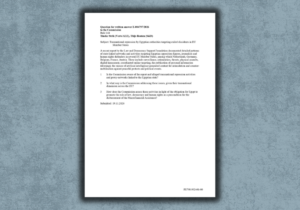

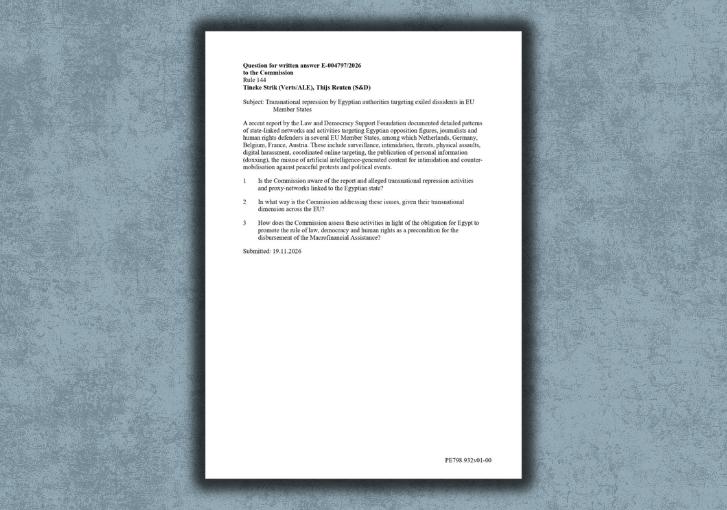
Two Members of the European Parliament have submitted a formal written question to the European Commission about transnational repression attributed to networks linked to the Egyptian authorities, targeting Egyptian dissidents and activists living in EU member states. Tineke Strik (Greens/EFA), the Parliament’s standing rapporteur on Egypt, and Thijs Reuten (S&D, Netherlands) based their question directly on a recent report by the Law and Democracy Support Foundation (LDSF).
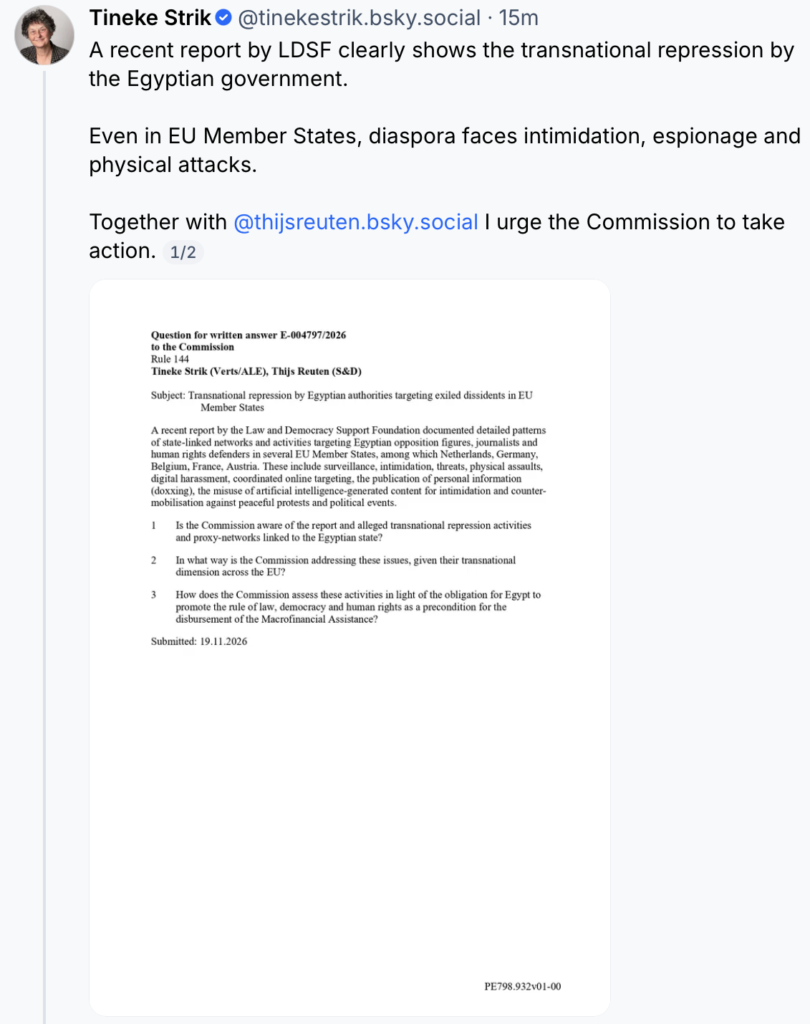
The question, numbered E-004797/2026, is titled “Transnational repression by the Egyptian authorities against Egyptian dissidents in exile in EU Member States.” In it, the two MEPs point to patterns documented in LDSF’s report: repeated surveillance, intimidation, threats and physical assaults, doxxing, the use of AI-generated content to smear and frighten people, and the targeting of political events and peaceful protests by Egyptian dissidents, journalists and human rights defenders in several European countries.
Announcing the question, Strik wrote that “a recent report by the Law and Democracy Support Foundation clearly shows the transnational repression carried out by the Egyptian government. Even within the EU, Egyptian communities face intimidation, spying and physical attacks.” She added that she had submitted the question together with Reuten to push the Commission to act.
The MEPs asked the Commission to clarify three things:
- Whether it is aware of the findings in LDSF’s report on transnational repression and on proxy networks linked to the Egyptian state.
- What mechanisms and measures the Commission and the EU have in place to deal with these practices, given that they cut across borders within the EU.
- How the Commission assesses these activities in light of Egypt’s commitments on the rule of law, democracy and human rights, particularly since these are among the conditions tied to the disbursement of the EU’s Macro-Financial Assistance package.
Background: the “Shield and Sword” report
The parliamentary move follows the publication of LDSF’s investigative report “Shield and Sword: The Role of the Union of Egyptian Youth Abroad in Transnational Repression Against Egyptian Dissidents in Europe.” The report documents transnational repression in six European countries (Germany, the Netherlands, Belgium, France, Austria and the United Kingdom) between 2022 and 2026. The violations it records include surveillance, intimidation, threats and physical assaults, online smear campaigns, the use of AI tools to target dissidents, and other practices aimed at undermining the political participation and free expression of Egyptians abroad.
The report also sheds light on the activities and leadership of the so-called “Union of Egyptian Youth Abroad,” which once described itself in a post as “the shield and sword of the Egyptian state abroad.” It links a number of incidents to individuals and networks whose names come up in more than one European country, in similar contexts involving the targeting of exiled Egyptian dissidents, human rights defenders and journalists.
The report was released as Dutch authorities announced they had widened their investigation into Ahmed Nasser, vice-president of the Union of Egyptian Youth Abroad, to include suspicion of providing services to a foreign power under Article 98d of the Dutch Criminal Code. The investigation is overseen by the Dutch National Public Prosecutor’s Office. This development came after years of complaints, legal memos and documentation submitted by LDSF to the relevant European authorities about transnational repression linked to networks working for the Egyptian authorities in several European countries. Taken together, the parliamentary question and the ongoing Dutch investigation suggest that the issue of Egyptian transnational repression is moving beyond human rights documentation and monitoring, and into scrutiny and accountability within European institutions.
LDSF says that bringing its findings into formal questioning in the European Parliament is an important step toward treating transnational repression as a systematic, cross-border threat that calls for a coordinated European response. That response should include stronger judicial and security cooperation, more information-sharing between member states, and effective protection for human rights defenders, journalists and political dissidents targeted outside their home countries.